
Battery Safety Knowledge Hub
Technical Risk
Testing & Validation Strategy
The value of a destructive battery test is not the certificate. It is the failure insight it creates.
TESTING SHOULD BE DESIGNED AROUND A QUESTION
Battery testing should not commence with the question, “Which test can we run?”.
Instead, the process should begin by asking, “What engineering uncertainty requires resolution?”. The selection oftest setup, trigger method, instrumentation, and system level should be guided by this objective.
Instead, the process should begin by asking, “What engineering uncertainty requires resolution?”. The selection oftest setup, trigger method, instrumentation, and system level should be guided by this objective.
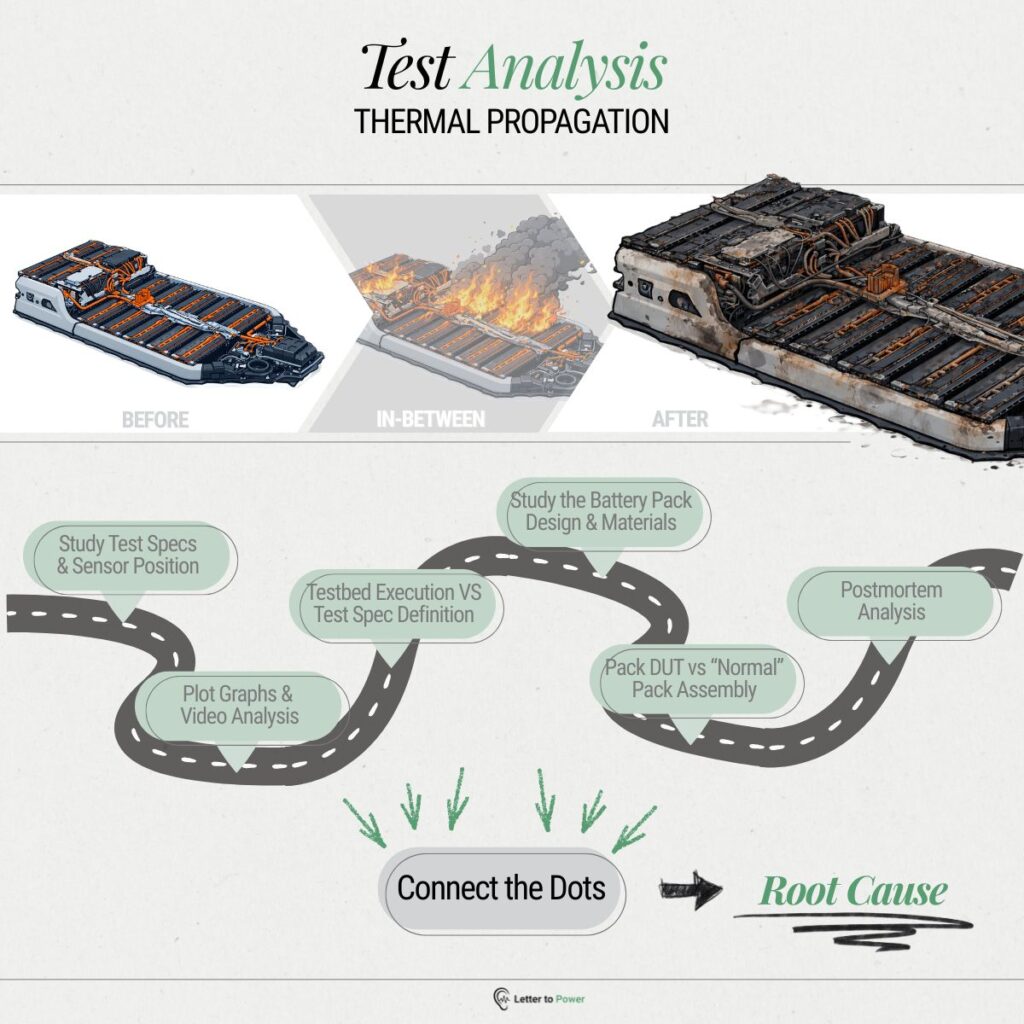
Is it possible to detect this cell prior to the onset of rapid thermal runaway?
The test should determine the intervals between the initial detectable changes, the first venting event, and the onset of rapid thermal runaway. This assessment establishes whether the selected sensor strategy offers a meaningful warning period.
The test should determine the intervals between the initial detectable changes, the first venting event, and the onset of rapid thermal runaway. This assessment establishes whether the selected sensor strategy offers a meaningful warning period.
What is the primary propagation pathway within the module?
The test should elucidate how failure propagates to neighbouring cells, whether through conduction, hot gas, particles, radiation, electrical effects, or a combination of these mechanisms.
The test should elucidate how failure propagates to neighbouring cells, whether through conduction, hot gas, particles, radiation, electrical effects, or a combination of these mechanisms.
How does the enclosure control vent gas and pressure?
The test setup should demonstrate the pathways of gas movement, locations of accumulation, pressure development, and the effectiveness of venting or relief features in managing gas release as designed.
The test setup should demonstrate the pathways of gas movement, locations of accumulation, pressure development, and the effectiveness of venting or relief features in managing gas release as designed.
Does the active system remain operational during a fault condition?
Cooling, ventilation, detection, and suppression systems should be evaluated under realistic fault conditions to determine whether they remain powered, functional, and effective throughout the event.
Cooling, ventilation, detection, and suppression systems should be evaluated under realistic fault conditions to determine whether they remain powered, functional, and effective throughout the event.
Is it possible for one enclosure to expose an adjacent enclosure to hazards?
A larger-scale test may be required to assess external flame, radiant heat, gas release, and other exposure pathways between adjacent units.
A larger-scale test may be required to assess external flame, radiant heat, gas release, and other exposure pathways between adjacent units.
Collectively, these questions ensure that testing remains focused on the specific design decisions that require empirical evidence. Therefore, an effective test is not defined by the extent of instrumentation or the size of the setup. Rather, it is characterized by its ability to reduce a specific uncertainty and generate evidence that supports a clear engineering decision.
BOUNDARY CONDITIONS MATTER
A battery test does not yield universally applicable conclusions regarding the cell or system. Test results are inherently dependent on the specific conditions under which failure is initiated, measured, and allowed to progress.
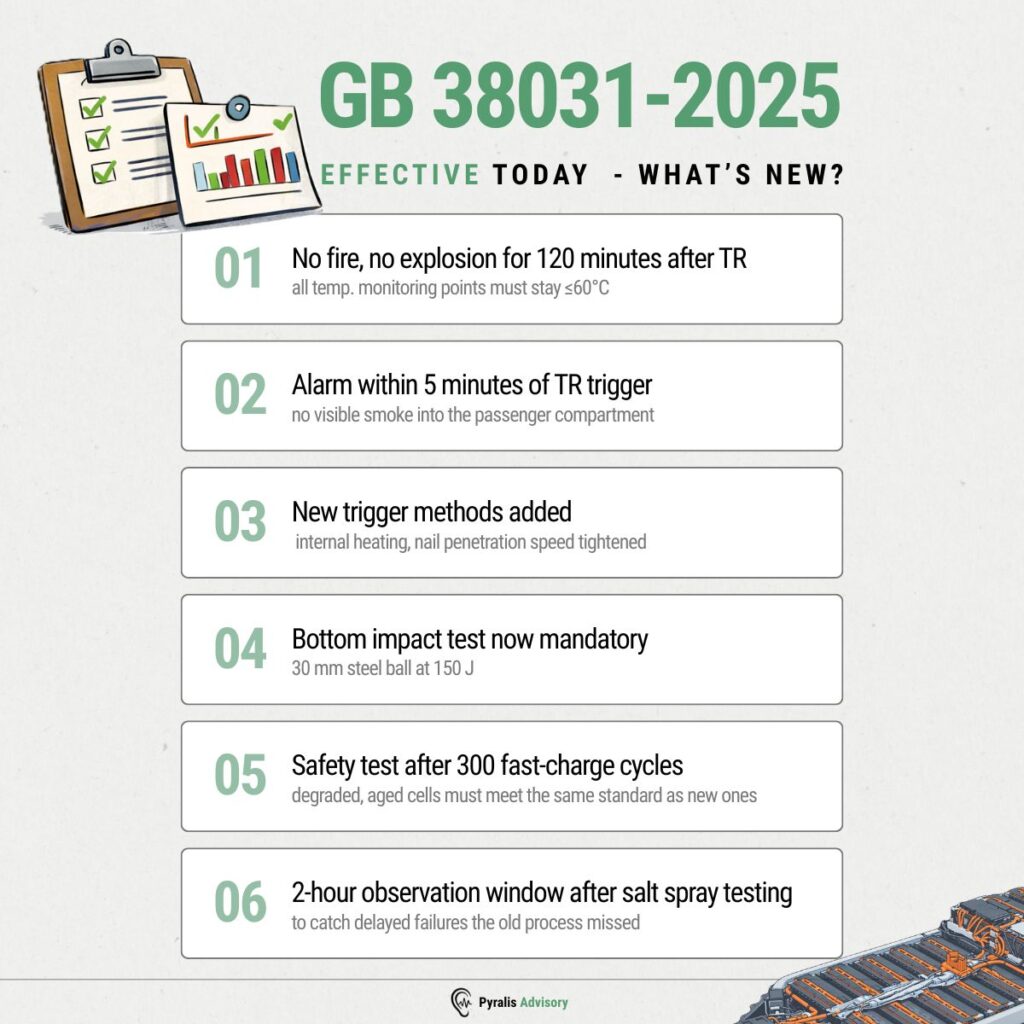
Trigger Method
External heating, nail penetration, internal short circuit, overcharge, and mechanical abuse each produce distinct failure behaviours. The chosen trigger method should align with the specific engineering question the test seeks to address.
External heating, nail penetration, internal short circuit, overcharge, and mechanical abuse each produce distinct failure behaviours. The chosen trigger method should align with the specific engineering question the test seeks to address.
State of Charge (SOC)
State of charge significantly affects both thermal stability and the severity of failure events. Results obtained at 50% SOC are not necessarily representative of systems operating near 100% SOC.
State of charge significantly affects both thermal stability and the severity of failure events. Results obtained at 50% SOC are not necessarily representative of systems operating near 100% SOC.
Cell Age and Condition
Fresh cells may exhibit different behaviours compared to aged, degraded, or previously stressed cells. Factors such as ageing history, swelling, impedance growth, and degradation mechanisms can alter both the onset and severity of failures.
Fresh cells may exhibit different behaviours compared to aged, degraded, or previously stressed cells. Factors such as ageing history, swelling, impedance growth, and degradation mechanisms can alter both the onset and severity of failures.
Cell Compression and Mounting
The method of cell restraint or installation can affect swelling, heat transfer, venting behaviour, and mechanical failure. Test configurations should accurately represent the relevant installation conditions.
The method of cell restraint or installation can affect swelling, heat transfer, venting behaviour, and mechanical failure. Test configurations should accurately represent the relevant installation conditions.
Cooling State
The status of the cooling system—active, inactive, or failed—determines the efficiency of heat removal from both initiating and neighbouring cells. This factor can significantly influence propagation behaviour and available response time.
The status of the cooling system—active, inactive, or failed—determines the efficiency of heat removal from both initiating and neighbouring cells. This factor can significantly influence propagation behaviour and available response time.
Ventilation State
Ventilation influences gas concentration, temperature, pressure development and ignition conditions. A freely ventilated test may not represent a confined enclosure.
Ventilation influences gas concentration, temperature, pressure development and ignition conditions. A freely ventilated test may not represent a confined enclosure.
Enclosure Configuration
The geometry, internal volume, openings, vent paths, and surrounding materials collectively determine the behaviour of heat, gas, and pressure following their release.
The geometry, internal volume, openings, vent paths, and surrounding materials collectively determine the behaviour of heat, gas, and pressure following their release.
Initiating-Cell Location
A failure occurring at the edge of a module may result in different exposure compared to a failure deep within the cell stack. Test locations should therefore represent credible worst-case or application-relevant scenarios.
A failure occurring at the edge of a module may result in different exposure compared to a failure deep within the cell stack. Test locations should therefore represent credible worst-case or application-relevant scenarios.
Instrumentation
The parameters measured and their locations determine the conclusions that can be drawn. Temperature measurements alone are insufficient to characterize gas release, pressure, particle emissions, electrical behaviour, or the complete propagation pathway.
The parameters measured and their locations determine the conclusions that can be drawn. Temperature measurements alone are insufficient to characterize gas release, pressure, particle emissions, electrical behaviour, or the complete propagation pathway.
Pass/Fail Criteria Versus Engineering Information
While pass/fail criteria may fulfill certification requirements, they can obscure valuable information regarding timing, failure pathways, and mitigation performance. Engineering analysis should extend beyond the final outcome.
While pass/fail criteria may fulfill certification requirements, they can obscure valuable information regarding timing, failure pathways, and mitigation performance. Engineering analysis should extend beyond the final outcome.
Collectively, these boundary conditions determine the true significance of a test result. In the absence of clearly defined boundary conditions, results may be inappropriately compared, or evidence may be applied beyond its valid range. A robust test program documents not only the observed outcomes, but also the precise conditions under which they occurred and the extent to which those conditions represent the actual system.
CELL → MODULE → PACK / UNIT → INSTALLATION
Battery testing addresses distinct questions at each hierarchical level. A cell-level result does not capture the complete behaviour of an enclosure, while a large-scale installation test cannot substitute for understanding the initiating cell. The most robust safety case builds evidence progressively, from the source of failure to the boundaries the system is designed to protect.
Cell Level: What does the initiating cell release?
Cell testing characterizes the source event, including thermal runaway behaviour, temperature profiles, vent gas composition and flammability, and other relevant failure characteristics. These results establish boundary conditions for system design. However, cell testing does not determine whether neighbouring cells will propagate failure or how the complete enclosure will manage the event.
Cell testing characterizes the source event, including thermal runaway behaviour, temperature profiles, vent gas composition and flammability, and other relevant failure characteristics. These results establish boundary conditions for system design. However, cell testing does not determine whether neighbouring cells will propagate failure or how the complete enclosure will manage the event.
Module Level: Can failure of one cell propagate to adjacent cells?
Module testing evaluates cell-to-cell thermal propagation and identifies dominant transfer mechanisms, heat and gas release behaviour, and potential ignition or deflagration hazards. This level of testing assesses local barriers, spacing, and module architecture, but does not fully represent pack-level gas management, electrical interactions, or site exposure.
Module testing evaluates cell-to-cell thermal propagation and identifies dominant transfer mechanisms, heat and gas release behaviour, and potential ignition or deflagration hazards. This level of testing assesses local barriers, spacing, and module architecture, but does not fully represent pack-level gas management, electrical interactions, or site exposure.
Pack or Unit Level: Can the system architecture contain the event?
At this level, the focus shifts from individual cells to the behaviour of the integrated battery unit, including propagation between internal groups, venting, electrical interfaces, cooling, detection, and active mitigation. Pack-level testing provides critical system-level evidence, but does not fully address interactions among multiple units or the effects on neighbouring equipment once installed.
At this level, the focus shifts from individual cells to the behaviour of the integrated battery unit, including propagation between internal groups, venting, electrical interfaces, cooling, detection, and active mitigation. Pack-level testing provides critical system-level evidence, but does not fully address interactions among multiple units or the effects on neighbouring equipment once installed.
Installation Level: What occurs beyond the individual unit?
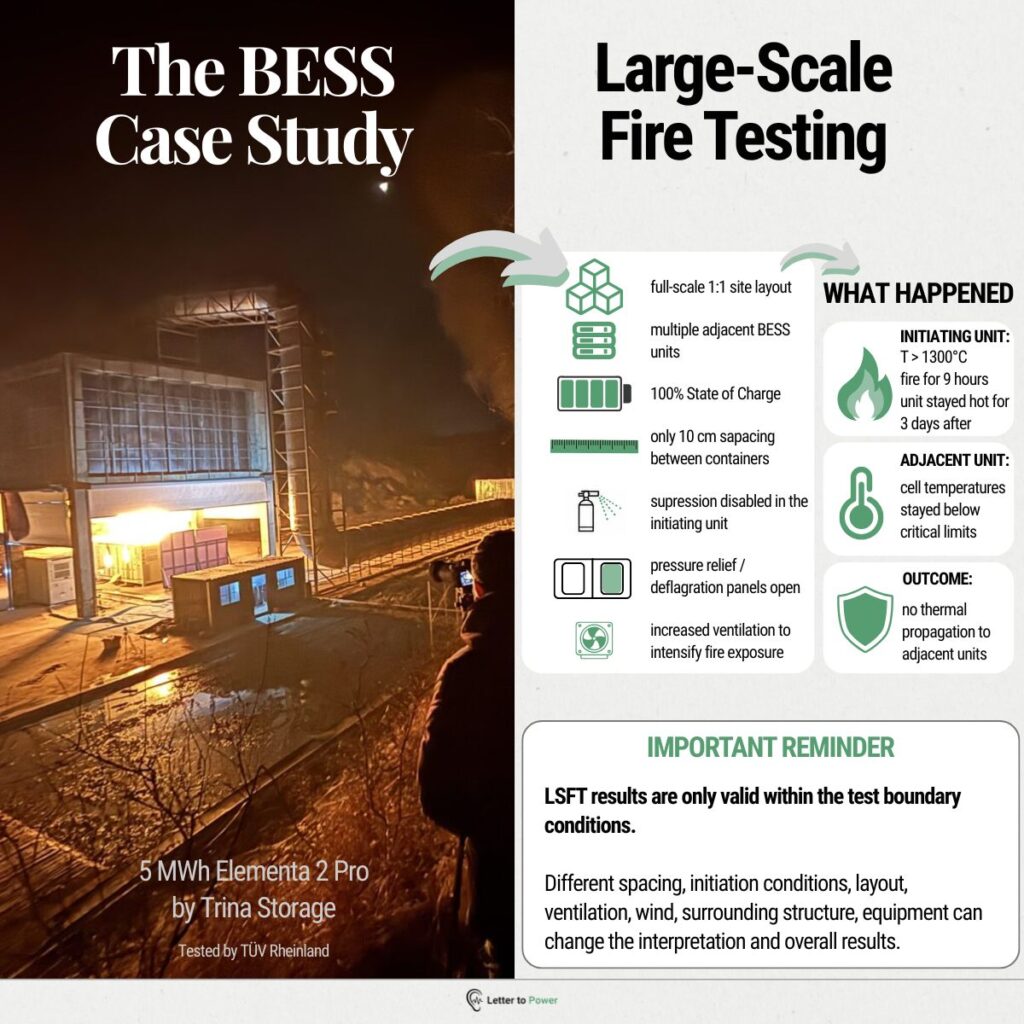
Large-scale testing evaluates consequences at the installation boundary, including fire exposure, heat and gas release, fire protection effectiveness, deflagration or re-ignition hazards, and exposure of neighbouring battery energy storage system (BESS) units. This level of testing begins to address whether a contained unit-level failure can escalate to a site-level event.
Large-scale testing evaluates consequences at the installation boundary, including fire exposure, heat and gas release, fire protection effectiveness, deflagration or re-ignition hazards, and exposure of neighbouring battery energy storage system (BESS) units. This level of testing begins to address whether a contained unit-level failure can escalate to a site-level event.
Collectively, these testing levels establish an evidence chain from initial cell failure to installation-level consequences. The critical consideration is not solely whether UL 9540A testing has been completed, but rather which levels were tested, under what conditions, what each test demonstrated, and whether the evidence accurately represents the actual installation.
Important UL 9540A edition note: As of August 2026, the current published standard is ANSI/CAN/UL 9540A, 6th Edition, published March 13, 2026. This distinction is significant. The 6th Edition retains cell- and module-level testing but substantially alters the subsequent test sequence. For applicable non-residential battery energy storage systems (BESS), the methodology advances to an installation-level large-scale fire test, rather than concluding after successful unit-level performance criteria. Unit-level testing remains particularly relevant for residential BESS and for evaluating active thermal runaway propagation prevention systems. UL has announced an effective date of January 1, 2027 for the 6th Edition. During the transition period, the edition referenced in any test report should always be stated explicitly.
PYRALIS SUPPORT
Testing delivers value only when the appropriate question is addressed, relevant data are collected, and the results inform a specific engineering decision. Pyralis supports the entire process, from test definition through result interpretation and subsequent engineering actions.
Test Plan Definition
I define the key questions the test must address, determine the appropriate system level, and identify necessary boundary conditions to ensure results are relevant for engineering decisions.
I define the key questions the test must address, determine the appropriate system level, and identify necessary boundary conditions to ensure results are relevant for engineering decisions.
Requirement Review
I review customer, regulatory, certification, and internal requirements against the planned test scope to identify missing evidence, ambiguous assumptions, or unnecessary testing.
I review customer, regulatory, certification, and internal requirements against the planned test scope to identify missing evidence, ambiguous assumptions, or unnecessary testing.
Trigger Method Selection and Evaluation
I assess the selected trigger method to ensure it aligns with the test objectives and produces representative failures without introducing artefacts that could distort the observed behaviour.
I assess the selected trigger method to ensure it aligns with the test objectives and produces representative failures without introducing artefacts that could distort the observed behaviour.
Instrumentation and Measured Output Review
I evaluate whether the proposed instrumentation can capture all required data, such as temperature, gas, pressure, electrical behaviour, timing, and other relevant outputs, and whether sensor placement enables meaningful interpretation.
I evaluate whether the proposed instrumentation can capture all required data, such as temperature, gas, pressure, electrical behaviour, timing, and other relevant outputs, and whether sensor placement enables meaningful interpretation.
Witnessing and Technical Support
For critical tests, Pyralis provides technical support during preparation and execution, assisting in the identification of deviations, unexpected behaviour, and additional observations that might otherwise be overlooked.
For critical tests, Pyralis provides technical support during preparation and execution, assisting in the identification of deviations, unexpected behaviour, and additional observations that might otherwise be overlooked.
Result Interpretation
I focus not only on test outcomes but also analyze the sequence of events, dominant pathways, and what the results demonstrate about the cell or system.
I focus not only on test outcomes but also analyze the sequence of events, dominant pathways, and what the results demonstrate about the cell or system.
Gap Analysis
I compare test results with the original engineering questions and safety assumptions to determine what has been demonstrated, what uncertainties remain, and where additional evidence is needed.
I compare test results with the original engineering questions and safety assumptions to determine what has been demonstrated, what uncertainties remain, and where additional evidence is needed.
Translation of Evidence into Design Action
The final step involves translating test results into actionable design changes, such as modifications to barriers, venting, cooling, detection, electrical isolation, system architecture, validation strategies, or operating assumptions.
The final step involves translating test results into actionable design changes, such as modifications to barriers, venting, cooling, detection, electrical isolation, system architecture, validation strategies, or operating assumptions.
Collectively, these activities ensure that testing is directly integrated with engineering decisions, rather than being treated as an isolated laboratory exercise. The objective of Pyralis support is to ensure that evidence addresses the correct questions under appropriate conditions and leads to clear, actionable steps for design or safety cases.
Sectors we support
Supporting organisations that design, test, evaluate, insure and shape battery and energy systems.
From battery developers and test facilities to insurers, system integrators and industry bodies.
BESS, Passenger & Commercial EV
Test Facilities, Standards & Industry Bodies
Battery Materials and Components
Fire protection & safety providers
Investors, Insurers & Due-diligence Teams
System integrators & OEMs

Let's start with focus session
Discuss a Battery Safety Problem
Battery safety problem, technical decision, commercial growth challenge or something in-between the two.