
Battery Safety Knowledge Hub
Technical Risk
Lithium-Ion Battery Thermal Runaway
Thermal runaway is often reduced to one dramatic moment: a temperature spike, flame or explosion. For engineering decisions, that is too late and too simple.
A useful thermal-runaway characterisation asks how the event develops, which signals appear first, how quickly the transition occurs and what the cell releases into the surrounding system.
THERMAL RUNAWAY IS NOT ONE TEMPERATURE
To understand cell behaviour during failure, it is necessary to determine when the event initiates, the rate of its development, and the resulting thermal load on the surrounding system. Consequently, thermal runaway characterization encompasses more than just the maximum cell temperature.
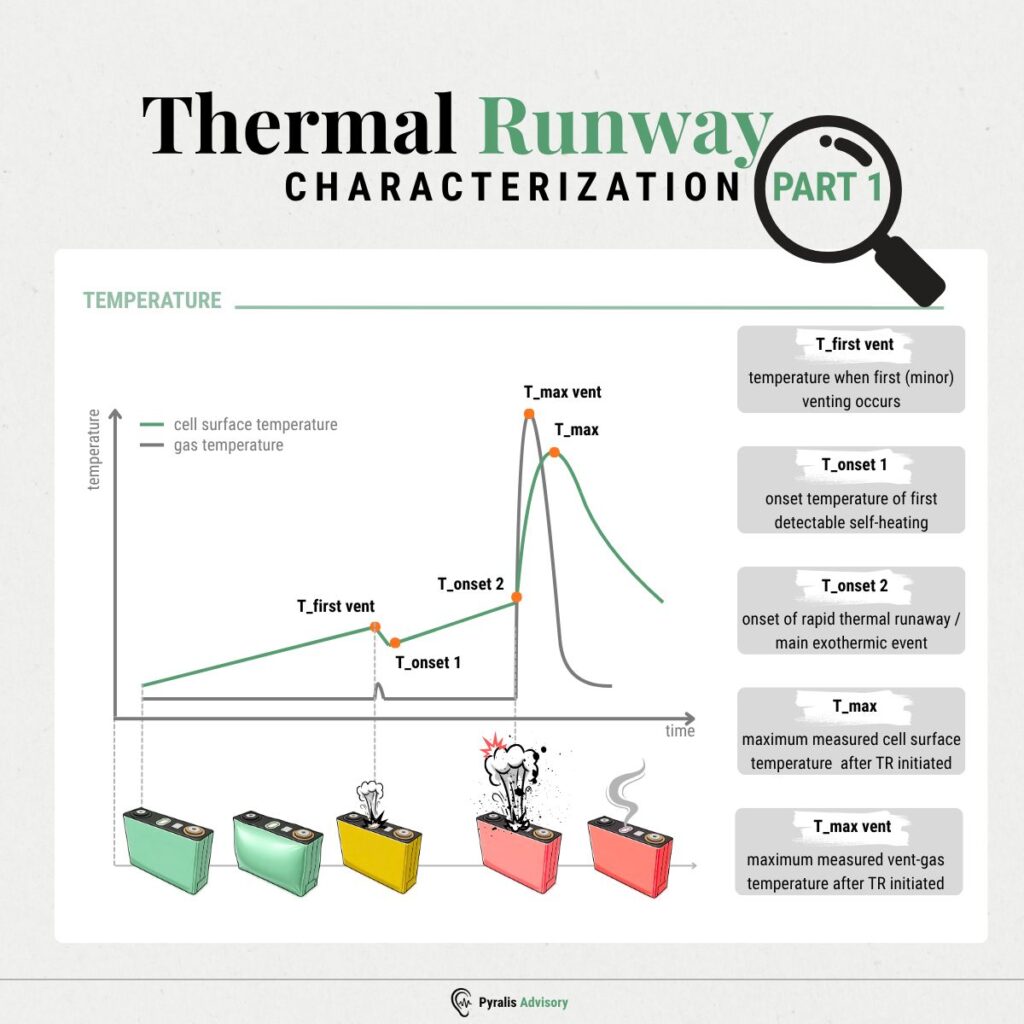
This stage marks the initial release of gas, electrolyte vapour, or other effluent from the cell. At this point, the issue extends beyond the cell itself, making gas detection, venting direction, and the surrounding system increasingly relevant.
This parameter refers to the earliest measurable point at which the cell generates abnormal heat. It defines the initial thermal warning window prior to event acceleration.
This point is characterized by a sharp acceleration in self-heating, marking the onset of the main exothermic event. At this stage, the focus shifts from preventing individual cell failure to containing its consequences.
This parameter represents the maximum temperature measured on the cell surface. It defines the thermal load imposed on neighbouring cells, barriers, cooling interfaces, and structural components.
When measured, this parameter indicates the temperature of released gas and ejecta. It is particularly important for vent-path design, material selection, particle exposure, and ignition risk assessment.
Total energy released does not fully describe event severity. A cell that releases heat and gas over several minutes presents a different challenge compared to a rapid release within seconds. The rate of energy release determines the available detection and response time, as well as the extent of loading on the surrounding system.
WHAT LEAVES THE CELL
The cell can release heat, gas, vapour, particles, and secondary electrical or mechanical effects. Each of these can drive broader system consequences.
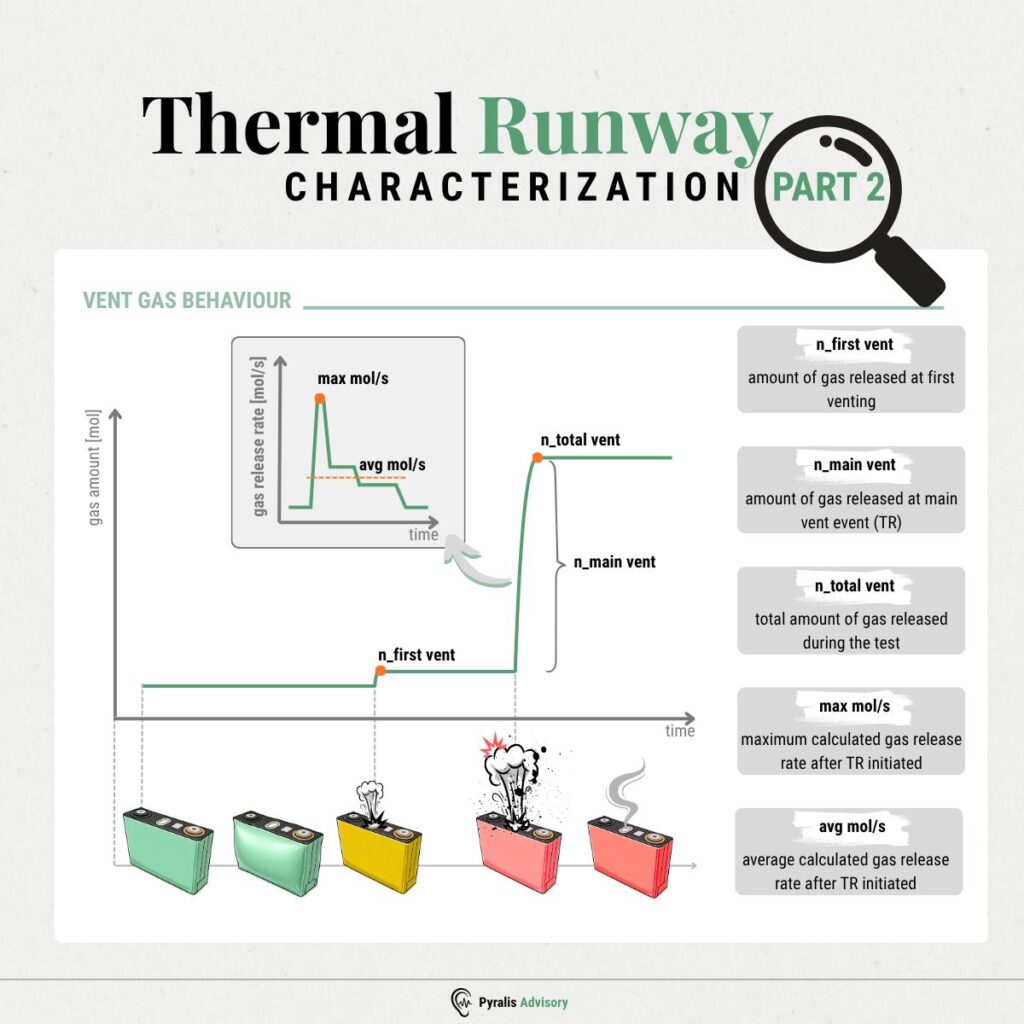
Heat is the primary driver of thermal loading on adjacent cells and surrounding materials. It determines the rate at which neighbouring parts approach failure and the available system response time.
The cell can release a mixture of flammable, toxic, and hot gases along with electrolyte vapour. The amount, composition, temperature, and release rate influence gas accumulation, ignition risk, toxicity, and venting system requirements.
Thermal runaway can also eject hot solid material, droplets, or fragments. These can transfer heat directly, damage nearby surfaces, erode insulation, and create additional ignition or propagation pathways.
A failing cell can create pressure buildup, swelling, casing rupture, short-circuiting, and damage to surrounding electrical interfaces. These secondary effects can escalate a local cell failure into a broader system event.
WHAT CHANGES THE EVENT
A single cell may exhibit markedly different failure modes depending on its chemistry, condition, triggering method, and surrounding environment.
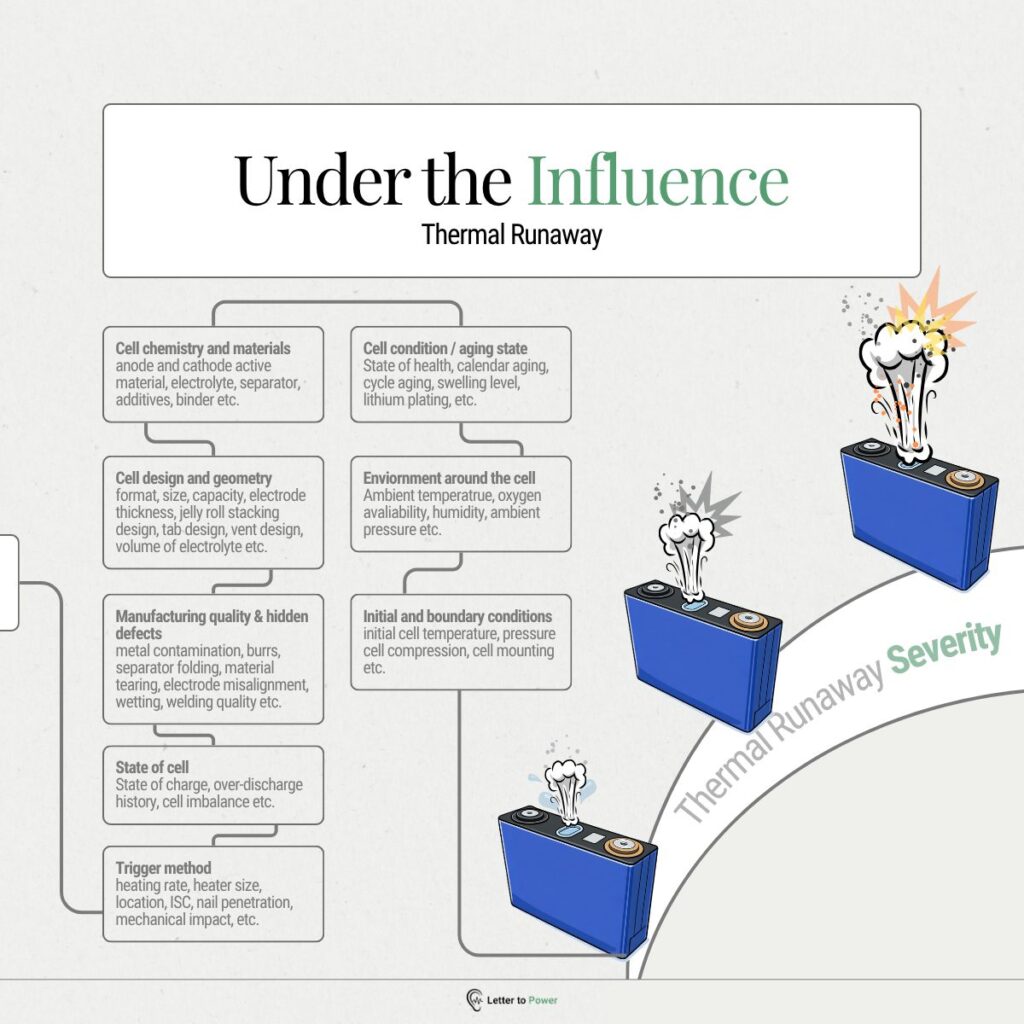
Cell chemistry determines fundamental failure characteristics, such as onset temperature, heat release, gas production, venting behaviour, and mass loss. Materials including the electrolyte, separator, and electrode design further influence the severity of the event.
Cylindrical, pouch and prismatic cells do not vent or fail in the same way. Format influences vent direction, casing behaviour, pressure build-up and ejection, while capacity affects how much energy, gas and material can be released.
The state of charge significantly influences the severity of thermal runaway events. Higher SOC typically reduces thermal stability and increases heat release, gas production, and overall event intensity.
Aged cells often fail differently compared to new cells. Factors such as degradation, swelling, lithium plating, increased impedance, and prior abuse can alter onset behaviour and affect both the severity and repeatability of thermal runaway.
Triggering mechanisms such as thermal heating, internal short circuit, nail penetration, overcharge, or mechanical abuse result in distinct failure behaviours. The chosen trigger method significantly influences event initiation, acceleration rate, and the parameters measured during testing.
Cell restraint, compression, and mounting conditions influence swelling, venting, heat transfer, and the progression of failure. Installation methods within the system can therefore significantly alter the characteristics of the event.
Initial temperature, ambient pressure, oxygen availability, enclosure conditions, and proximity to other materials all affect the development of thermal runaway events. Results observed in open laboratory setups may differ substantially from those within operational battery systems.
WHY THIS MATTERS AT SYSTEM LEVEL
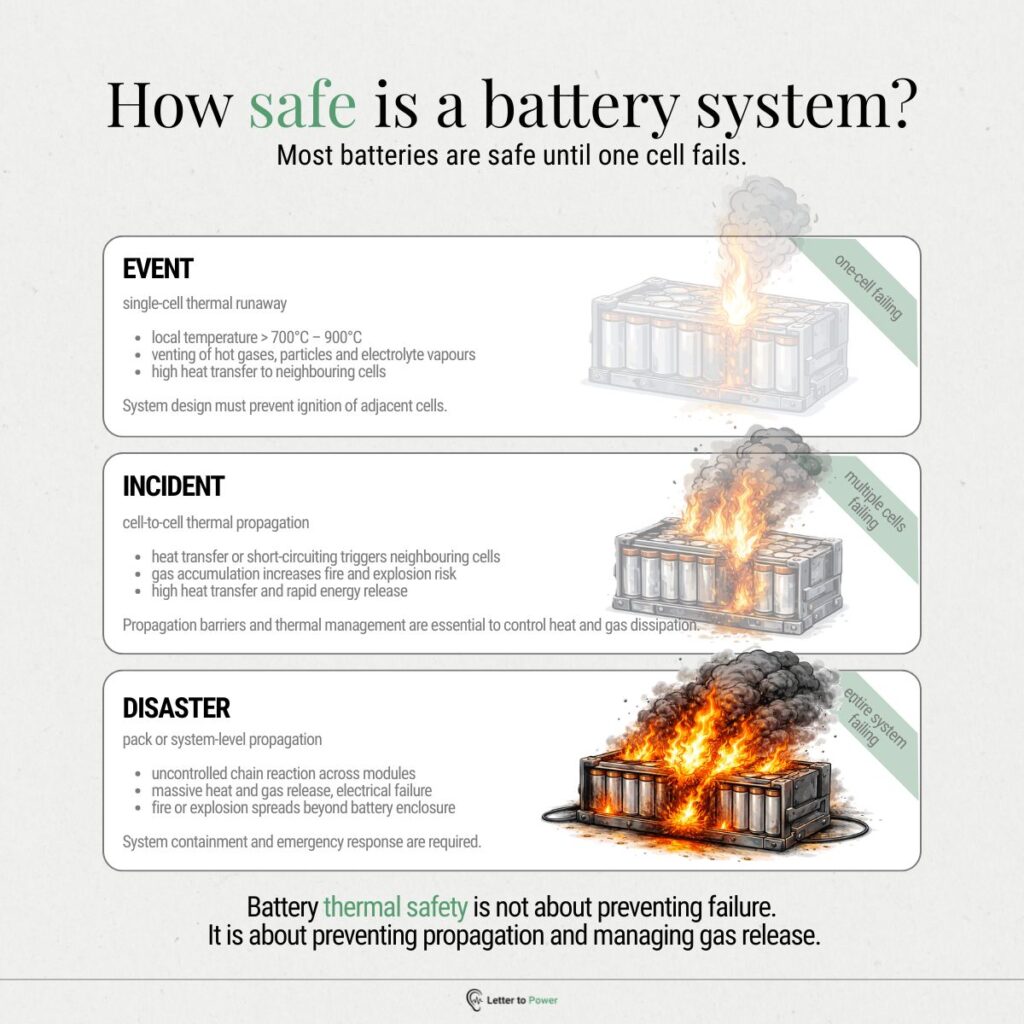
Early self-heating, initial venting, and gas release behaviours inform the selection of detectable signals, optimal sensor placement, and the required sensitivity of alarm logic.
Heat release, peak temperatures, and event duration determine the effectiveness of cooling in delaying propagation and inform the selection of appropriate active or passive mitigation measures surrounding the cell.
Surface temperature, vent-gas temperature, particle emission, and release intensity determine the necessary degree of thermal separation between cells, modules, and adjacent components.
Gas volume, release rate, and venting behaviour serve as direct inputs for vent-path design, pressure relief sizing, and the management of flammable or high-temperature effluent within the system.
The quantity, composition, and timing of gas release determine the most relevant gas species for monitoring and assess the potential of gas detection as an early warning mechanism.
Thermal events may damage insulation, busbars, connectors, and nearby high-voltage components. Consequently, cell failure behaviour directly influences the design of electrical separation and emergency disconnect strategies.
Thermal runaway data supplies essential source terms for modelling heat transfer, gas release, and failure escalation. In the absence of realistic cell-level input, system-level propagation models lack accuracy.
Cell-level data defines the necessary test parameters, conditions, and hierarchical levels—from cell to module, pack, or container—to ensure that the safety case accurately represents the actual system.
Sectors we support
Supporting organisations that design, test, evaluate, insure and shape battery and energy systems.
From battery developers and test facilities to insurers, system integrators and industry bodies.
BESS, Passenger & Commercial EV
Test Facilities, Standards & Industry Bodies
Battery Materials and Components
Fire protection & safety providers
Investors, Insurers & Due-diligence Teams
System integrators & OEMs

Let's start with focus session
Discuss a Battery Safety Problem
Battery safety problem, technical decision, commercial growth challenge or something in-between the two.