
Battery Safety Knowledge Hub
Technical Risk
BESS Safety & Thermal Risk
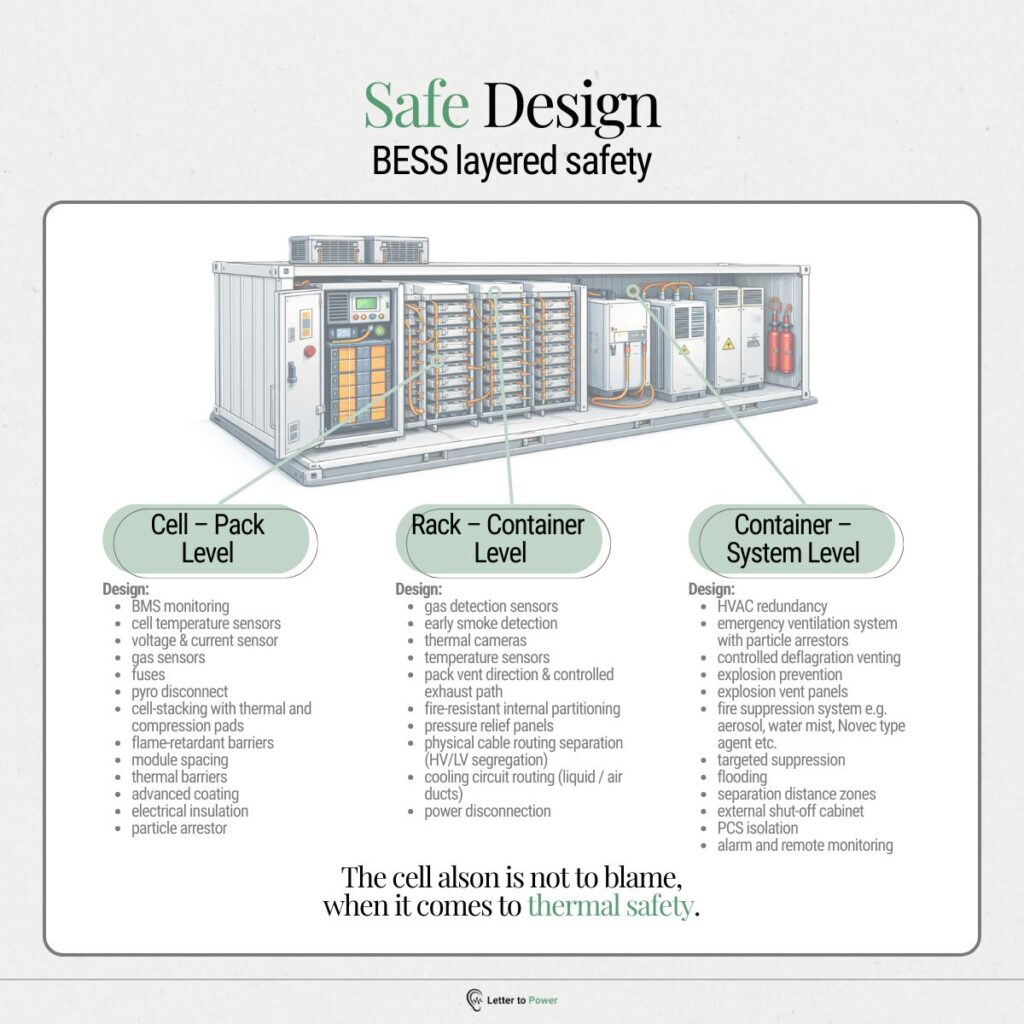
The same cell failure can become a minor incident or a major claim. The difference is usually created by the system around the cell.
A HOLISTIC BESS RISK VIEW
Assessment of BESS risk should extend beyond the cell or container level. A comprehensive safety assessment tracks the event from initiation through escalation, exposure, and eventual recovery.
FAILURE: What initiates the event?
The initial consideration is the cause of the event. Potential initiators include cell defects, electrical faults, cooling failures, integration issues, control errors, mechanical damage, ageing, or other system-level failure modes.
The initial consideration is the cause of the event. Potential initiators include cell defects, electrical faults, cooling failures, integration issues, control errors, mechanical damage, ageing, or other system-level failure modes.
PROPAGATION: How does the event spread across cells, modules, racks, or enclosures?
Once failure occurs, the primary concern is the extent and speed of its propagation. Factors such as heat, gas, particles, electrical faults, and system architecture influence whether the event remains localized or breaches subsequent design boundaries.
Once failure occurs, the primary concern is the extent and speed of its propagation. Factors such as heat, gas, particles, electrical faults, and system architecture influence whether the event remains localized or breaches subsequent design boundaries.
EXPOSURE: Which equipment, buildings, personnel, and neighbouring units are at risk of exposure?
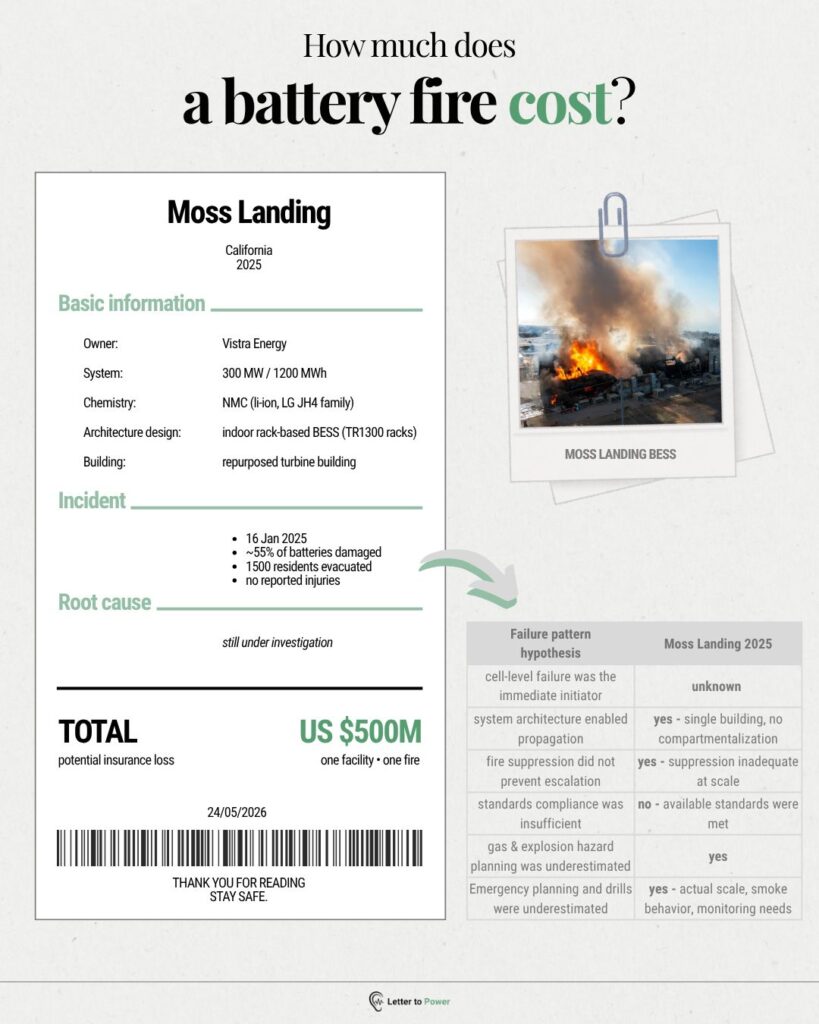
Identical failures may result in varying consequences depending on the surrounding environment. Factors such as adjacent containers, electrical infrastructure, occupied buildings, emergency access, and site layout influence the ultimate severity.
Identical failures may result in varying consequences depending on the surrounding environment. Factors such as adjacent containers, electrical infrastructure, occupied buildings, emergency access, and site layout influence the ultimate severity.
RECOVERY: What processes are necessary for investigation, clean-up, replacement, recommissioning, and return to service?
The incident does not conclude once the fire is extinguished. Investigation, contamination assessment, removal of damaged equipment, replacement lead times, regulatory review, testing, and recommissioning often determine the total downtime and associated costs.
The incident does not conclude once the fire is extinguished. Investigation, contamination assessment, removal of damaged equipment, replacement lead times, regulatory review, testing, and recommissioning often determine the total downtime and associated costs.
Collectively, these four dimensions define the actual consequences of a BESS failure. While a failed cell may initiate the event, system architecture, surrounding exposure, and the complexity of recovery determine whether the incident remains a contained technical issue or escalates into a significant operational and financial loss.
WHAT PYRALIS REVIEWS
A comprehensive BESS safety review must integrate cell behaviour, system architecture, operational conditions and site-level consequences. The objective is to determine not only the presence of individual safety features, but also their collective effectiveness in containing credible failures within acceptable boundaries.
Cell Chemistry, Format and Evidence
The selected cell, including its chemistry, format, capacity and available thermal-runaway evidence, is reviewed to assess the source severity that the system must address.
The selected cell, including its chemistry, format, capacity and available thermal-runaway evidence, is reviewed to assess the source severity that the system must address.
Rack / Enclosure Architecture
The physical arrangement of cells, modules, racks and enclosures determines the ease with which heat, gas, particles and secondary faults propagate through the system.
The physical arrangement of cells, modules, racks and enclosures determines the ease with which heat, gas, particles and secondary faults propagate through the system.
Cooling and Ventilation
Both normal thermal management and system behaviour during fault conditions are assessed, including scenarios where cooling, HVAC or ventilation is unavailable or exacerbates the failure.
Both normal thermal management and system behaviour during fault conditions are assessed, including scenarios where cooling, HVAC or ventilation is unavailable or exacerbates the failure.
Venting Paths, Gas Accumulation and Pressure Management
The review traces gas release points, movement through the enclosure, potential accumulation sites and the management of pressure or flammable atmospheres.
The review traces gas release points, movement through the enclosure, potential accumulation sites and the management of pressure or flammable atmospheres.
Electrical Layout / BOS Failure Pathways
Failures may originate outside the cell, as wiring, connectors, auxiliary circuits, cooling equipment and other balance-of-system components can initiate or amplify thermal events.
Failures may originate outside the cell, as wiring, connectors, auxiliary circuits, cooling equipment and other balance-of-system components can initiate or amplify thermal events.
Detection Strategy
The review examines system monitoring parameters, early warning signals, sensor placement and the relationship between detection time and the available propagation window.
The review examines system monitoring parameters, early warning signals, sensor placement and the relationship between detection time and the available propagation window.
Passive and Active Mitigation
Barriers, spacing, cooling, isolation, ventilation and suppression measures are evaluated in relation to the specific propagation pathways they are designed to control.
Barriers, spacing, cooling, isolation, ventilation and suppression measures are evaluated in relation to the specific propagation pathways they are designed to control.
Fire / Explosion Assumptions
The assessment critically examines assumptions regarding ignition, gas accumulation, flame spread, deflagration and the conditions that could allow a thermal event to escalate beyond the battery.
The assessment critically examines assumptions regarding ignition, gas accumulation, flame spread, deflagration and the conditions that could allow a thermal event to escalate beyond the battery.
UL 9540A and Other Test Evidence
Test reports are analyzed beyond pass or fail outcomes, considering initiation methods, state of charge, configuration, boundary conditions, propagation behaviour and the representativeness of the evidence for the deployed system.
Test reports are analyzed beyond pass or fail outcomes, considering initiation methods, state of charge, configuration, boundary conditions, propagation behaviour and the representativeness of the evidence for the deployed system.
Separation and Site Layout
Container spacing, proximity to neighbouring equipment and buildings, access routes and surrounding exposures influence whether a contained battery event could escalate to a broader site-level loss.
Container spacing, proximity to neighbouring equipment and buildings, access routes and surrounding exposures influence whether a contained battery event could escalate to a broader site-level loss.
Ageing, Alarms, Maintenance and Augmentation
The safety case evolves over time, as operating history, degradation, repeated alarms, maintenance quality and cell or system replacement may alter the original risk assumptions.
The safety case evolves over time, as operating history, degradation, repeated alarms, maintenance quality and cell or system replacement may alter the original risk assumptions.
Emergency Response Assumptions
The review considers the expected performance of isolation, monitoring, access, suppression, evacuation and fire-service response once an event has commenced.
The review considers the expected performance of isolation, monitoring, access, suppression, evacuation and fire-service response once an event has commenced.
Recovery / Business Interruption Implications
The review also addresses post-incident actions, including investigation, clean-up, equipment replacement, recommissioning and the potential duration of asset unavailability.
The review also addresses post-incident actions, including investigation, clean-up, equipment replacement, recommissioning and the potential duration of asset unavailability.
Collectively, these areas provide a system-level perspective on failure initiation, amplification and the factors that ultimately determine the consequences. The purpose of a Pyralis review is not solely to identify individual hazards, but to determine whether the overall safety architecture can prevent a local failure from escalating into a major technical, operational or financial event.
TESTING IS EVIDENCE, NOT A CHECKBOX
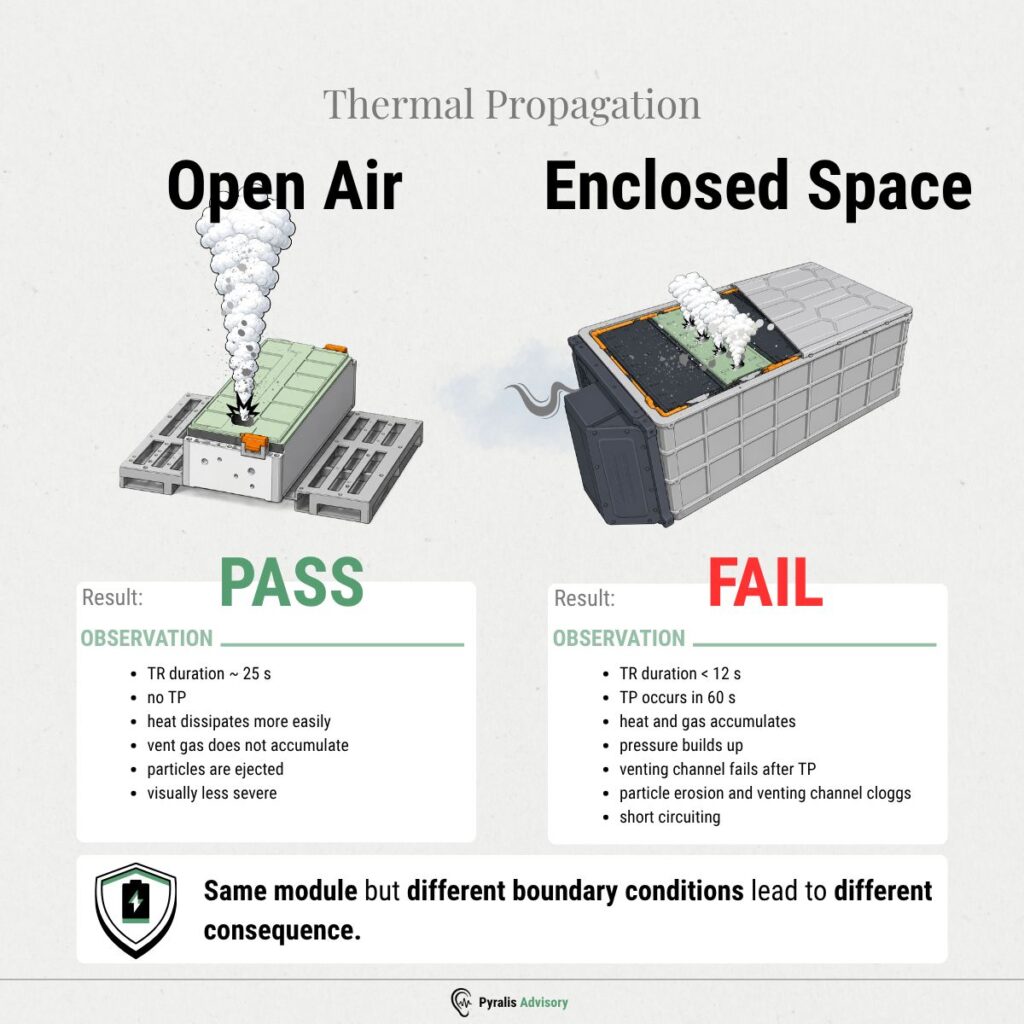
The utility of a test result depends on the specific conditions under which it was generated and the particular engineering question it addresses. Certification or a successful test outcome does not guarantee uniform behaviour across all deployed systems.
Scope of Demonstrated Evidence
Begin by identifying the specific evidence demonstrated by the test, such as whether propagation occurred, the management of gas and heat, the maintenance of neighbouring units below critical thresholds, or the effectiveness of a particular mitigation strategy.
Begin by identifying the specific evidence demonstrated by the test, such as whether propagation occurred, the management of gas and heat, the maintenance of neighbouring units below critical thresholds, or the effectiveness of a particular mitigation strategy.
Limitations of Test Evidence
All tests have inherent boundaries. Results may not reflect behaviour at different states of charge, with alternative trigger methods, after component ageing, under varied ventilation conditions, or in alternative system configurations. These limitations must remain explicit when using the evidence for safety decisions.
All tests have inherent boundaries. Results may not reflect behaviour at different states of charge, with alternative trigger methods, after component ageing, under varied ventilation conditions, or in alternative system configurations. These limitations must remain explicit when using the evidence for safety decisions.
Relevance to Site-Specific and Operational Conditions
It is essential to determine whether the tested configuration accurately reflects the actual installation, including cell condition, system architecture, spacing, ventilation, surrounding exposures, and operating conditions. Technically valid evidence may still lack representativeness for the real site.
It is essential to determine whether the tested configuration accurately reflects the actual installation, including cell condition, system architecture, spacing, ventilation, surrounding exposures, and operating conditions. Technically valid evidence may still lack representativeness for the real site.
Collectively, these considerations transform a test report into substantive engineering evidence rather than a mere compliance formality. The value of testing lies not solely in a system’s successful outcome, but in understanding what the test reveals about actual failure behaviour, identifying areas of uncertainty, and assessing whether the evidence substantiates the safety assumptions for the deployed system.
Sectors we support
Supporting organisations that design, test, evaluate, insure and shape battery and energy systems.
From battery developers and test facilities to insurers, system integrators and industry bodies.
BESS, Passenger & Commercial EV
Test Facilities, Standards & Industry Bodies
Battery Materials and Components
Fire protection & safety providers
Investors, Insurers & Due-diligence Teams
System integrators & OEMs

Let's start with focus session
Discuss a Battery Safety Problem
Battery safety problem, technical decision, commercial growth challenge or something in-between the two.