
Battery Safety Knowledge Hub
Technical Risk
Battery Incident & Crisis Support
Battery problems rarely arrive in a tidy sequence. A test fails, a field issue appears, evidence conflicts, multiple teams arrive with different priorities and important decisions must be made before the root cause is fully known.
WHEN THIS SUPPORT IS USEFUL
Pyralis support provides the greatest value in situations characterized by technical uncertainty, elevated risk, or significant commercial implications. Such scenarios typically require rapid response, thorough incident analysis, and prompt decision-making by technical teams.
Abuse or Propagation Test Failure
When a test yields unexpected results, the initial priority is to determine the root cause, whether it originates from the cell, trigger method, experimental setup, system design, or underlying test assumptions.
When a test yields unexpected results, the initial priority is to determine the root cause, whether it originates from the cell, trigger method, experimental setup, system design, or underlying test assumptions.
Unexpected Cell Behaviour
Atypical venting, temperature response, gas release, rupture, or propagation behaviour may suggest that current safety assumptions are either incomplete or outdated.
Atypical venting, temperature response, gas release, rupture, or propagation behaviour may suggest that current safety assumptions are either incomplete or outdated.
Detection or Mitigation Failure
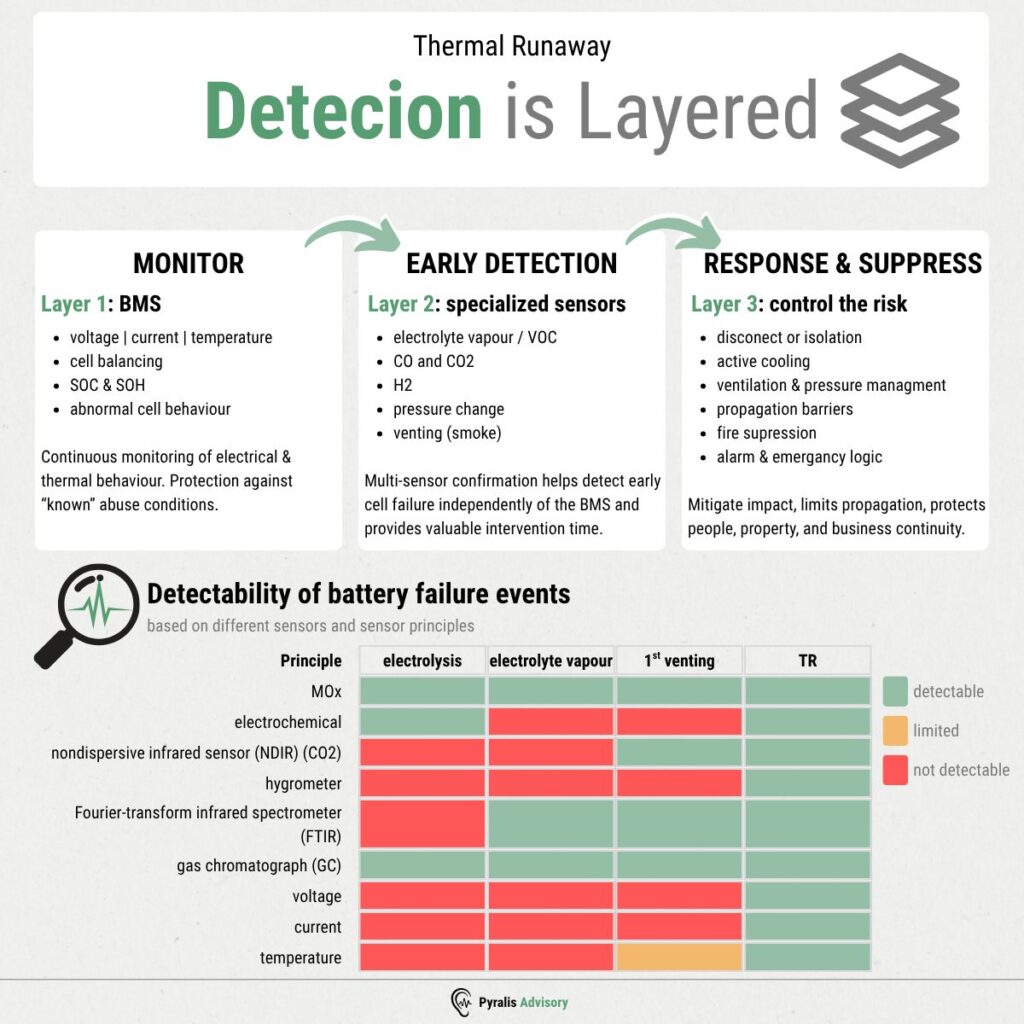
If sensors, cooling systems, barriers, ventilation, or suppression mechanisms fail to operate as intended, it is essential to reconstruct the failure pathway prior to determining subsequent countermeasures.
If sensors, cooling systems, barriers, ventilation, or suppression mechanisms fail to operate as intended, it is essential to reconstruct the failure pathway prior to determining subsequent countermeasures.
Pack or Enclosure Damage
Damage to the housing, venting structures, electrical components, or adjacent modules can reveal propagation mechanisms that were not identified during the initial design review.
Damage to the housing, venting structures, electrical components, or adjacent modules can reveal propagation mechanisms that were not identified during the initial design review.
Supplier Dispute
In cases of unclear responsibility, an independent technical review can distinguish evidence from assumptions and clarify the capabilities and limitations of the available data.
In cases of unclear responsibility, an independent technical review can distinguish evidence from assumptions and clarify the capabilities and limitations of the available data.
Field Event
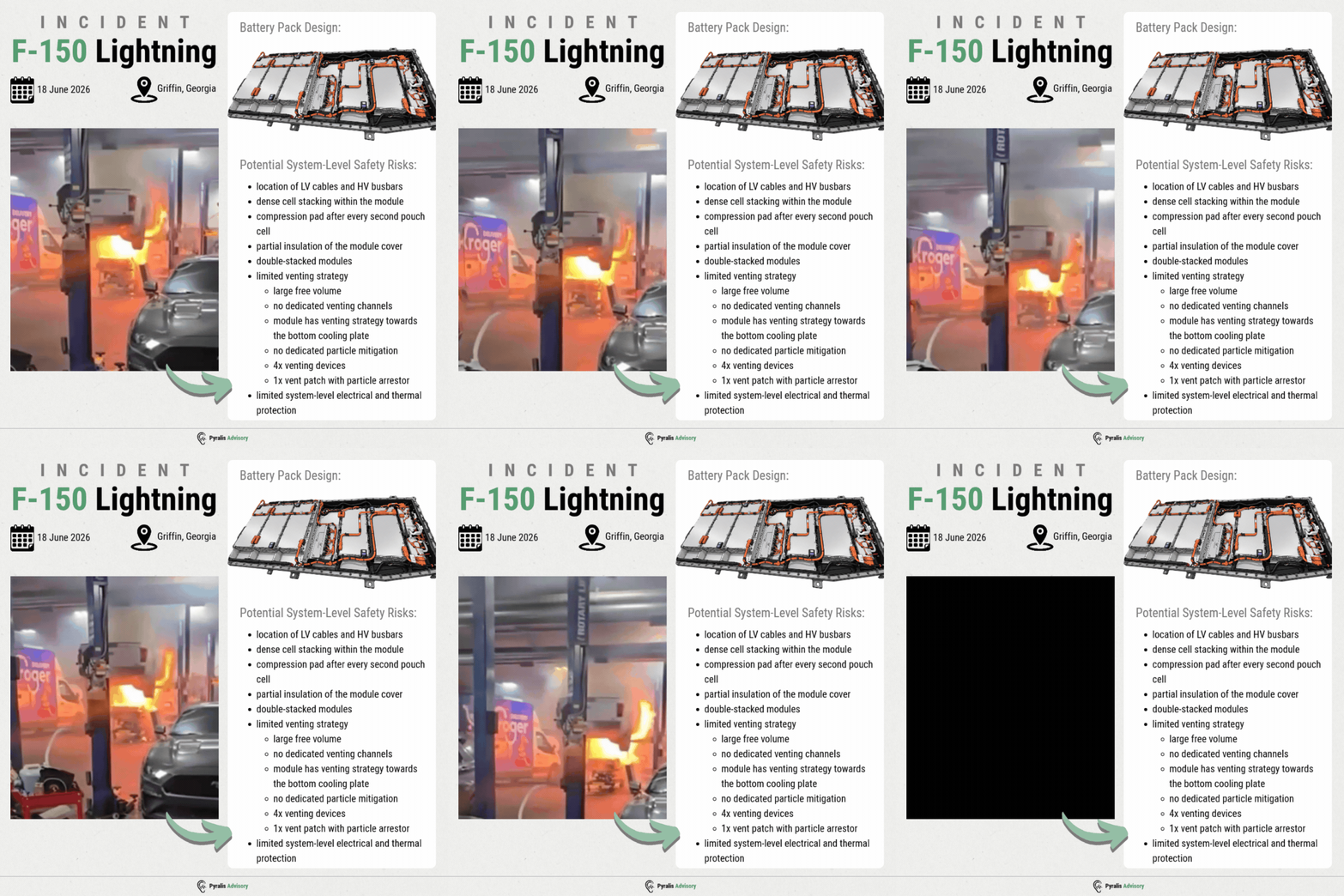
A real-world incident necessitates rapid technical interpretation of incomplete information. The primary objective is to identify credible failure pathways, assess immediate risks, and determine which evidence should be preserved or further investigated.
A real-world incident necessitates rapid technical interpretation of incomplete information. The primary objective is to identify credible failure pathways, assess immediate risks, and determine which evidence should be preserved or further investigated.
Repeated Quality Issue
Recurring abnormalities may indicate a systemic issue rather than isolated variation. A structured review facilitates the connection between manufacturing processes, cell behaviour, system integration, and operational history.
Recurring abnormalities may indicate a systemic issue rather than isolated variation. A structured review facilitates the connection between manufacturing processes, cell behaviour, system integration, and operational history.
High-Stakes Management Decision
When decisions impact launch timing, supplier selection, redesign, product safety, or significant financial exposure, management requires a technically substantiated assessment of the available evidence, uncertainties, and potential options.
When decisions impact launch timing, supplier selection, redesign, product safety, or significant financial exposure, management requires a technically substantiated assessment of the available evidence, uncertainties, and potential options.
Cross-Functional Task Force
Complex battery issues typically span multiple departments. Pyralis provides support to engineering, testing, quality, management, suppliers, and other stakeholders to develop a unified understanding of failures and required actions.
Complex battery issues typically span multiple departments. Pyralis provides support to engineering, testing, quality, management, suppliers, and other stakeholders to develop a unified understanding of failures and required actions.
Collectively, these situations have one thing in common: the cost of making the wrong technical decision is high. Pyralis support transforms fragmented test results, observations, and assumptions into a structured failure analysis, prioritized actions, and an evidence-based course of action.
THE WORK
When technical problems become complex, the primary objective should not be to increase activity. Instead, focus on clarifying the problem, the available evidence, and the necessary decisions.
Clarify the technical question
Before attempting to solve the issue, I assist in defining the core problem, identifying the blocked decision, and determining which questions require immediate attention.
Before attempting to solve the issue, I assist in defining the core problem, identifying the blocked decision, and determining which questions require immediate attention.
Establish a shared evidence base
I consolidate test results, design documentation, field observations, supplier data, and prior analyses to ensure all stakeholders operate from a unified technical foundation.
I consolidate test results, design documentation, field observations, supplier data, and prior analyses to ensure all stakeholders operate from a unified technical foundation.
Distinguish facts, hypotheses, and unknowns
I differentiate confirmed evidence from engineering assumptions and unresolved questions. This approach prevents teams from prematurely accepting hypotheses as established root causes.
I differentiate confirmed evidence from engineering assumptions and unresolved questions. This approach prevents teams from prematurely accepting hypotheses as established root causes.
Identify credible failure pathways
I reconstruct the event from initiation through propagation and consequence to determine mechanisms that plausibly explain the observed behaviour.
I reconstruct the event from initiation through propagation and consequence to determine mechanisms that plausibly explain the observed behaviour.
Prioritize tests and analyses that most effectively reduce uncertainty
Not every unresolved question requires additional testing. I identify which experiment, simulation, inspection, or analysis will yield the most valuable evidence for subsequent decisions.
Not every unresolved question requires additional testing. I identify which experiment, simulation, inspection, or analysis will yield the most valuable evidence for subsequent decisions.
Translate findings into actionable design, validation, or management steps
I convert technical conclusions into clear next steps, such as design modifications, additional validation, supplier engagement, containment measures, or management decisions.
I convert technical conclusions into clear next steps, such as design modifications, additional validation, supplier engagement, containment measures, or management decisions.
Facilitate alignment among engineering, management, suppliers, and other stakeholders
Complex technical challenges often involve multiple teams with varying priorities and interpretations. I foster a shared understanding of the evidence, risks, and required actions.
Complex technical challenges often involve multiple teams with varying priorities and interpretations. I foster a shared understanding of the evidence, risks, and required actions.
Collectively, these steps establish a structured pathway from technical uncertainty to informed decision and action. The objective is not merely to generate additional analyses or reports, but to rapidly reduce uncertainty, align stakeholders, and advance the problem toward a technically defensible resolution.
THE OUTPUT
The value of technical support extends beyond the analysis itself. Effective technical support should result in clear decisions, well-documented reasoning, and a practical path forward for the team.
Decision Memorandum
A concise summary should outline the technical situation, key findings, remaining uncertainties, and recommended subsequent decisions or actions.
A concise summary should outline the technical situation, key findings, remaining uncertainties, and recommended subsequent decisions or actions.
Failure Pathway Map
A structured visual representation should illustrate how failure may initiate, propagate, and generate broader consequences across the cell, module, pack, or system.
A structured visual representation should illustrate how failure may initiate, propagate, and generate broader consequences across the cell, module, pack, or system.
Risk and Hypothesis Register
A comprehensive record should document confirmed risks, working hypotheses, open questions, and the evidence required to accept, reject, or refine each item.
A comprehensive record should document confirmed risks, working hypotheses, open questions, and the evidence required to accept, reject, or refine each item.
Investigation Plan
A prioritized plan should detail inspections, data reviews, testing, simulations, or supplier input necessary to address the most critical technical gaps.
A prioritized plan should detail inspections, data reviews, testing, simulations, or supplier input necessary to address the most critical technical gaps.
Test Priorities
A focused list should identify the tests that will most rapidly reduce uncertainty, specifying the objective of each test and its relevance to decision-making.
A focused list should identify the tests that will most rapidly reduce uncertainty, specifying the objective of each test and its relevance to decision-making.
Mitigation Actions
Specific design, validation, operational, or containment measures should be directly linked to the identified failure pathways and supporting evidence.
Specific design, validation, operational, or containment measures should be directly linked to the identified failure pathways and supporting evidence.
Technical Workshop and Task Force Facilitation
Structured sessions should engage engineering, management, suppliers, and other stakeholders around a unified evidence base, a single problem definition, and an agreed-upon action plan.
Structured sessions should engage engineering, management, suppliers, and other stakeholders around a unified evidence base, a single problem definition, and an agreed-upon action plan.
Collectively, these outputs transform a complex technical issue into an actionable framework. The objective is to provide the team with a clear technical position, transparent uncertainties, prioritized next steps, and alignment regarding subsequent actions.
Sectors we support
Supporting organisations that design, test, evaluate, insure and shape battery and energy systems.
From battery developers and test facilities to insurers, system integrators and industry bodies.
BESS, Passenger & Commercial EV
Test Facilities, Standards & Industry Bodies
Battery Materials and Components
Fire protection & safety providers
Investors, Insurers & Due-diligence Teams
System integrators & OEMs

Let's start with focus session
Discuss a Battery Safety Problem
Battery safety problem, technical decision, commercial growth challenge or something in-between the two.